


Note
This tutorial is compatible with Gymnasium version 1.4.0.
Action Masking in the Taxi Environment
This tutorial demonstrates how to use action masking in the Taxi environment to improve reinforcement learning performance by preventing invalid actions. It assumes familiarity with tabular Q-learning, for example from Solving Blackjack with Tabular Q-Learning.
Dependencies: pip install "gymnasium[toy-text]" matplotlib.
The Taxi environment is a classic grid world problem where a taxi needs to pick up a passenger and drop them off at their destination. In this environment, not all actions are valid at every state - for example, you can’t drive through walls or pick up a passenger when you’re not at their location.
Action masking is a technique that helps reinforcement learning agents avoid selecting invalid actions by providing a binary mask that indicates which actions are valid in the current state. This can significantly improve learning efficiency and performance.
Understanding the Taxi Environment
The Taxi environment has 6 possible actions:
0: Move south (down)
1: Move north (up)
2: Move east (right)
3: Move west (left)
4: Pickup passenger
5: Drop off passenger
The environment provides an action_mask in the info dictionary returned by reset() and step().
This mask is a binary array where 1 indicates a valid action and 0 indicates an invalid action.
How Action Masking Works
Action masking works by constraining the agent’s action selection to only valid actions:
During exploration: when selecting random actions, we only choose from the set of valid actions.
During exploitation: when selecting the best action based on Q-values, we only consider Q-values for valid actions.
During Q-learning updates: we compute the maximum future Q-value only over valid actions in the next state.
Let’s implement this step by step:
from pathlib import Path

import matplotlib.pyplot as plt
import numpy as np

import gymnasium as gym

# Base random seed for reproducibility
BASE_RANDOM_SEED = 58922320


def train_q_learning(
    env,
    use_action_mask: bool = True,
    episodes: int = 5000,
    seed: int = BASE_RANDOM_SEED,
    learning_rate: float = 0.1,
    discount_factor: float = 0.95,
    epsilon: float = 0.1,
) -> dict:
    """Train a Q-learning agent with or without action masking."""
    # Set random seeds for reproducibility
    np.random.seed(seed)
    env.action_space.seed(seed)

    # Initialize Q-table
    n_states = env.observation_space.n
    n_actions = env.action_space.n
    q_table = np.zeros((n_states, n_actions))

    # Track episode rewards for analysis
    episode_rewards = []

    for episode in range(episodes):
        # Reset environment
        state, info = env.reset(seed=seed + episode)
        total_reward = 0
        terminated = False
        truncated = False

        while not (terminated or truncated):
            # Get action mask if using it
            action_mask = info["action_mask"] if use_action_mask else None

            # Epsilon-greedy action selection with masking
            if np.random.random() < epsilon:
                # Random action selection. ``Discrete.sample`` accepts a mask and
                # only samples actions where the mask is 1.
                action = env.action_space.sample(mask=action_mask)
            else:
                # Greedy action selection
                if use_action_mask:
                    # Only consider valid actions for exploitation
                    valid_actions = np.nonzero(action_mask == 1)[0]
                    if len(valid_actions) > 0:
                        action = valid_actions[np.argmax(q_table[state, valid_actions])]
                    else:
                        action = np.random.randint(0, n_actions)
                else:
                    # Consider all actions
                    action = np.argmax(q_table[state])

            # Take action and observe result
            next_state, reward, terminated, truncated, info = env.step(action)
            total_reward += reward

            # Q-learning update
            if use_action_mask:
                # Only consider valid next actions for bootstrapping
                next_mask = info["action_mask"]
                valid_next_actions = np.nonzero(next_mask == 1)[0]
                if len(valid_next_actions) > 0:
                    next_max = np.max(q_table[next_state, valid_next_actions])
                else:
                    next_max = 0
            else:
                # Consider all next actions
                next_max = np.max(q_table[next_state])

            # Update Q-value. The update runs on every step, including the last one,
            # so the final drop-off reward is learned. Only a terminal state
            # (``terminated``) has no future value; a time-limit truncation still
            # bootstraps from ``next_state``.
            td_target = reward + discount_factor * (1 - terminated) * next_max
            q_table[state, action] = q_table[state, action] + learning_rate * (
                td_target - q_table[state, action]
            )

            state = next_state

        episode_rewards.append(total_reward)

    return {
        "episode_rewards": episode_rewards,
        "mean_reward": np.mean(episode_rewards),
        "std_reward": np.std(episode_rewards),
    }
Running the Experiment
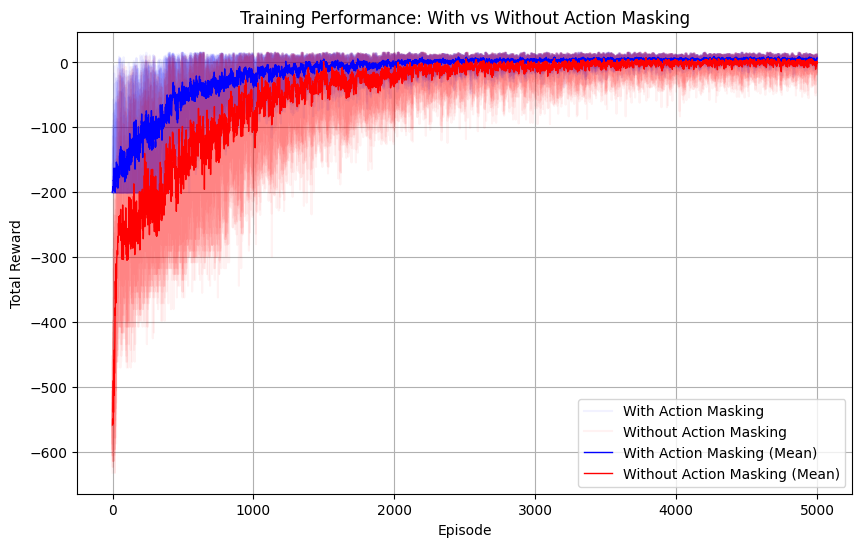
Now we’ll run experiments to compare the performance of Q-learning agents with and without action masking. We’ll use multiple random seeds to ensure robust statistical comparison.
The experiment setup:
12 independent runs with different random seeds
5000 episodes per run
Standard Q-learning hyperparameters
(α=0.1, γ=0.95, ε=0.1)
# Experiment parameters
n_runs = 12
episodes = 5000
learning_rate = 0.1
discount_factor = 0.95
epsilon = 0.1

# Generate different seeds for each run
seeds = [BASE_RANDOM_SEED + i for i in range(n_runs)]

# Store results for comparison
masked_results_list = []
unmasked_results_list = []

# Run experiments with different seeds
for i, seed in enumerate(seeds):
    print(f"Run {i + 1}/{n_runs} with seed {seed}")

    # Train agent WITH action masking
    env_masked = gym.make("Taxi-v4")
    masked_results = train_q_learning(
        env_masked,
        use_action_mask=True,
        seed=seed,
        learning_rate=learning_rate,
        discount_factor=discount_factor,
        epsilon=epsilon,
        episodes=episodes,
    )
    env_masked.close()
    masked_results_list.append(masked_results)

    # Train agent WITHOUT action masking
    env_unmasked = gym.make("Taxi-v4")
    unmasked_results = train_q_learning(
        env_unmasked,
        use_action_mask=False,
        seed=seed,
        learning_rate=learning_rate,
        discount_factor=discount_factor,
        epsilon=epsilon,
        episodes=episodes,
    )
    env_unmasked.close()
    unmasked_results_list.append(unmasked_results)
Visualizing Results
After running all experiments, we calculate statistics and create visualizations to compare the performance of both approaches.
# Calculate statistics across runs
masked_mean_rewards = [r["mean_reward"] for r in masked_results_list]
unmasked_mean_rewards = [r["mean_reward"] for r in unmasked_results_list]

masked_overall_mean = np.mean(masked_mean_rewards)
masked_overall_std = np.std(masked_mean_rewards)
unmasked_overall_mean = np.mean(unmasked_mean_rewards)
unmasked_overall_std = np.std(unmasked_mean_rewards)

# Create visualization
plt.figure(figsize=(12, 8), dpi=100)

# Plot individual runs with low alpha
for i, (masked_results, unmasked_results) in enumerate(
    zip(masked_results_list, unmasked_results_list, strict=True)
):
    plt.plot(
        masked_results["episode_rewards"],
        label="With Action Masking" if i == 0 else None,
        color="blue",
        alpha=0.1,
    )
    plt.plot(
        unmasked_results["episode_rewards"],
        label="Without Action Masking" if i == 0 else None,
        color="red",
        alpha=0.1,
    )

# Calculate and plot mean curves across all runs
masked_mean_curve = np.mean([r["episode_rewards"] for r in masked_results_list], axis=0)
unmasked_mean_curve = np.mean(
    [r["episode_rewards"] for r in unmasked_results_list], axis=0
)

plt.plot(
    masked_mean_curve, label="With Action Masking (Mean)", color="blue", linewidth=2
)
plt.plot(
    unmasked_mean_curve,
    label="Without Action Masking (Mean)",
    color="red",
    linewidth=2,
)

plt.xlabel("Episode")
plt.ylabel("Total Reward")
plt.title("Training Performance: Q-Learning with vs without Action Masking")
plt.legend()
plt.grid(True, alpha=0.3)

# Save the figure
savefig_folder = Path("_static/img/tutorials/")
savefig_folder.mkdir(parents=True, exist_ok=True)
plt.savefig(
    savefig_folder / "taxi_v3_action_masking_comparison.png",
    bbox_inches="tight",
    dpi=150,
)
plt.show()
Results Analysis
The comparison demonstrates several important benefits of using action masking:
Faster convergence: agents with action masking learn faster because they don’t waste time exploring invalid actions.
Better performance: by focusing only on valid actions, the agent achieves higher rewards more consistently.
More stable learning: action masking reduces the variance in learning by eliminating the randomness associated with invalid action selection.
Practical applicability: in real-world scenarios, action masking prevents agents from taking actions that could be dangerous or impossible.
Reminder of the key implementation details:
Action selection: we filter available actions using
np.nonzero(action_mask == 1)[0]to get only valid actions.Q-value updates: when computing the maximum future Q-value, we only consider valid actions in the next state. The update also runs on the final step of an episode; only
terminatedremoves the bootstrapped future value, while a time-limittruncatedstill bootstraps.Exploration: random action selection uses
env.action_space.sample(mask=action_mask), which only samples valid actions.
This approach ensures that the agent never selects invalid actions while still maintaining the exploration-exploitation balance necessary for effective learning.